
Search
FPC Design Guidelines: Ultimate DFM, Production & QC Best Practices for High-Reliability Flexible PCBs
- Jun 29,2026
-
Share
In the fast-evolving consumer electronics, automotive, medical, and wearable tech industries, Flexible Printed Circuits (FPCs) have become an indispensable core component, renowned for their ultra-thin thickness, high flexibility, lightweight structure, and dynamic bending resistance. Unlike rigid PCBs, FPC design requires strict compliance with specialized layout rules, manufacturability standards, and quality control protocols to eliminate bending fatigue, trace cracking, delamination, and electrical failure risks. For electronic designers, mastering standardized FPC design guidelines is the key to balancing product performance, production yield, manufacturing cost, and long-term operational reliability.
As a professional global FPC, PCB, and rigid-flex PCB ODM/OEM manufacturer, Shenzhen Huaruixin Electronics Co., Ltd. has accumulated in-depth industry experience in high-precision FPC customization, mass production, and quality testing. Based on thousands of project cases and front-end production feedback, we share targeted FPC design, production optimization, and QC detection guidelines from a designer’s perspective, helping design teams avoid common pitfalls and achieve seamless docking with industrial mass production.
1. Professional FPC Layout Design Guidelines (Designer-Focused Core Standards)
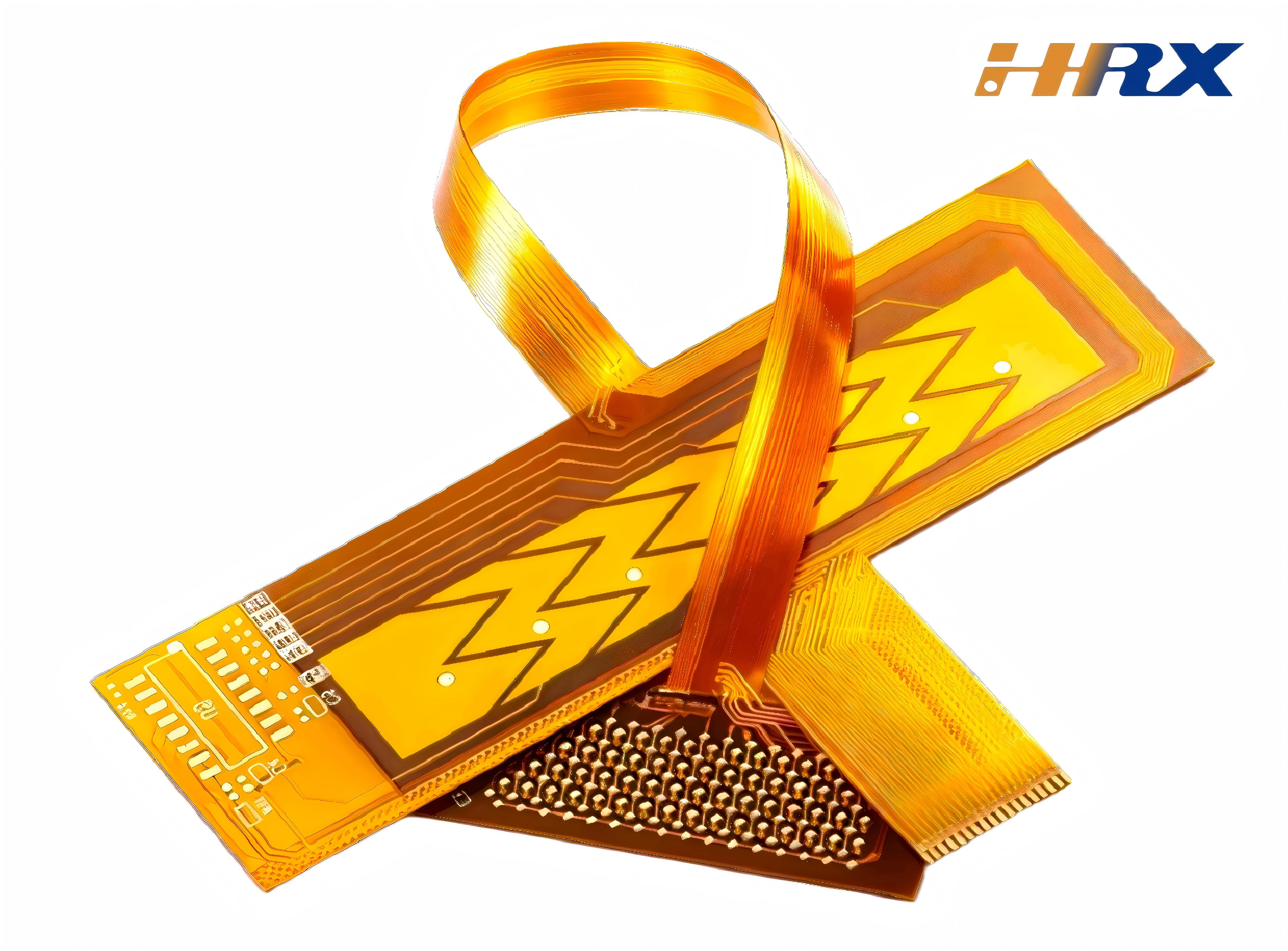
FPC structural design directly determines product flexibility, electrical stability, and production feasibility. All layout designs must follow IPC-2223 industry standards and prioritizeDesign for Manufacturability (DFM) to resolve design-production incompatibility issues fundamentally.
1.1 Bend Zone & Mechanical Structure Optimization
Dynamic and static bend zones are the most failure-prone areas of FPCs. Designers must strictly distinguish flexible bend zones and rigid reinforcement zones in the initial layout stage. For dynamic bending FPCs (repeated folding and stretching), follow the standard bend radius principle: 6x board thickness for static bending and 20x board thickness for high-frequency dynamic bending. Avoid 90° right-angle traces in bend zones, adopt arc or 45° oblique routing, and arrange all traces perpendicular to the bending axis to reduce copper foil fatigue and fracture.
Meanwhile, prohibit via holes, component pads, large-area copper foils, and solder mask openings in pure bend zones. Concentrated stress from vias and uneven copper thickness will cause irreversible cracking during long-term bending cycles. For rigid-flex hybrid boards, designers need to standardize the rigid-flex transition zone layout to avoid abrupt structural changes and stress concentration.
1.2 Trace, Pad & Via Layout Specifications
Precision line width and spacing design is critical for high-density FPCs. For consumer-grade standard FPCs, maintain a minimum trace width/spacing of 75μm; for high-precision medical and automotive FPCs, control advanced precision of 50μm. Adopt teardrop pad design for all connection pads to enhance trace-pad connectivity and prevent open circuits caused by bending stress.
In terms of via design, prioritize blind and buried vias for high-layer FPCs to save layout space and improve structural stability. Control the via aspect ratio below 1:1 to ensure uniform electroplating copper deposition and avoid poor hole conduction. All through-hole vias must be covered by coverlay to prevent short circuits and oxidation caused by exposed copper.
1.3 Material Matching & Stackup Design
Reasonable material selection is the foundation of FPC reliability. Designers should match materials according to product application scenarios: adopt polyimide (PI) substrate for high-temperature resistant and high-flexibility scenarios, and rolled annealed (RA) copper foil instead of electrolytic copper foil to improve bending resistance. For thick-copper FPCs used in power circuits, select 1/2oz or 1oz copper foil reasonably, and balance copper density on the upper and lower layers to avoid board warpage and delamination during production.
2. FPC Production-Oriented DFM Optimization Rules
Many FPC design schemes with perfect theoretical performance face low yield, high rework rate, and increased costs in mass production. As a professional ODM/OEM FPC manufacturer, Huaruixin Electronics summarizes exclusive DFM optimization experiences for designers, realizing high-efficiency and low-cost mass production.
2.1 Simplify Complex Structures to Improve Yield
Designers should avoid excessive irregular cutouts, narrow slots, and ultra-fine gaps in FPC layout. Special-shaped structures require laser cutting and secondary processing, which greatly reduce production efficiency and increase burr and dimensional deviation risks. For non-functional areas, simplify the outline structure and maintain uniform edge spacing to adapt to batch stamping and cutting processes.
2.2 Coverlay & Solder Mask Process Adaptation
Unreasonable coverlay opening design is a common cause of FPC short circuits and oxidation. Designers need to reserve a reasonable coverlay margin for pads and functional areas to avoid offset exposure during lamination. For FPCs requiring surface gold plating or tin plating, unify the opening size to prevent electroplating leakage and uneven coating thickness. In addition, reserve process positioning holes and fiducial marks in the layout to improve SMT mounting accuracy and production alignment efficiency.
2.3 Batch Production Cost Control Design
On the premise of meeting performance requirements, designers can optimize the layer structure and reduce redundant stacking layers to lower material and processing costs. For multi-specification small-batch projects, adopt standardized modular layout designs to shorten production proofing cycles and improve ODM/OEM customized production flexibility.
3. FPC Quality Inspection & Testing Standards (QC & QA Guidelines)
Strict quality inspection is the final guarantee of FPC product reliability. Combining industrial mainstream testing standards and our factory’s mature quality control system, we sort out core inspection indicators for designers’ reference, facilitating targeted design optimization for testability.
3.1 Dimensional & Structural Inspection
Adopt high-precision CNC dimension measuring instruments and 2D imagers to detect FPC outline size, hole position accuracy, line width spacing tolerance, and rigid-flex transition zone flatness. Eliminate defective products with dimensional deviation, board warpage, and coverlay offset to ensure assembly compatibility with terminal products.
3.2 Electrical Performance Testing
Conduct open/short circuit testing, insulation resistance testing, and impedance testing for all finished FPCs. For high-frequency and high-precision FPCs used in 5G devices and automotive electronics, add high-frequency signal integrity testing to avoid signal attenuation and crosstalk caused by unreasonable layout.
3.3 Mechanical & Environmental Reliability Testing
Perform professional bending fatigue tests, tensile tests, and peel strength tests on FPCs to verify the stability of bend zones and bonding layers. Meanwhile, conduct high and low temperature cycling, humidity resistance, and salt spray tests to adapt to complex application scenarios of automotive, industrial control, and medical equipment, ensuring long-term service life of FPCs.
4. Huaruixin Electronics’ Unique Industry Insights & Professional Suggestions
With years of in-depth cultivation in global FPC, PCB, and rigid-flex PCB ODM/OEM customized manufacturing, Shenzhen Huaruixin Electronics Co., Ltd. has formed unique industry cognition and practical design optimization suggestions for pain points in the FPC industry such as low bending resistance, poor batch consistency, and long proofing cycles:
First, design must be fully coupled with production processes. Most designers focus on terminal performance while ignoring production process limitations. We suggest design teams communicate with manufacturers in advance in the early proofing stage, confirm factory process capabilities (minimum line width/spacing, minimum bend radius, via precision), and adjust layout schemes in real time to avoid repeated revisions and delayed project cycles.
Second, prioritize reliability design for differentiated scenarios. Consumer electronics FPCs focus on cost and lightweight design, while automotive and medical FPCs need to strengthen anti-fatigue, anti-oxidation, and anti-interference design. We recommend adding shielding layer design and thickened gold plating process for high-reliability scenarios to improve product anti-interference ability and welding stability.
Third, realize iterative optimization of design and testing. Combine QC testing data to summarize design flaws, continuously optimize bend zone layout, material matching, and structural design, and form a closed loop of "design-production-testing-optimization" to steadily improve product batch yield and market competitiveness.
Contact Us for Professional FPC & Rigid-Flex PCB Customization
Shenzhen Huaruixin Electronics Co., Ltd. is a professional global ODM/OEM manufacturer specializing in high-precision FPC, rigid PCB, and rigid-flex PCB customized production. We support one-stop services from design consultation, DFM optimization, rapid proofing, mass production to full-quality testing, serving global customers in consumer electronics, automotive electronics, medical devices, industrial control, and wearable industries.
If you have FPC, PCB, or rigid-flex PCB project customization, proofing, and mass production needs, please feel free to contact us at any time. For more professional FPC design guidelines, industry technical knowledge, and product solutions, please visit our official website:www.hrxfpc.com. You can also send technical consultation and cooperation demands via email: sales@hrxfpc.com. We are willing to communicate, learn, and progress together with global industry partners!

Let’s talk! We’ll provide the perfect solution for you!
-
 Huaruixin Electronics mainly produces printed circuit boards as the core business, to provide customers with one-stop solutions for FPC/PCB production, components sourcing and Assembly.
 - WHAT WE DO — PCB Design Solutions — Flex PCB Production — Components Sourcing — FPC&PCB Assembly
- PRODUCTS — Single Sided Flexible Circuits — Double Sided Flexible Circuits — Multilayer Flexible Cirucits — Rigid-Flex Circuits — FPC Assembly — PCB Assembly
- CAPABILITY — FPC Capability — Rigid-Flex Capability — PCB Capability — Assembly Capability
- Copyright © 2024 Shenzhen Huaruixin Electronics Co., Ltd. All Rights Reserved.
- Design By BONTOP